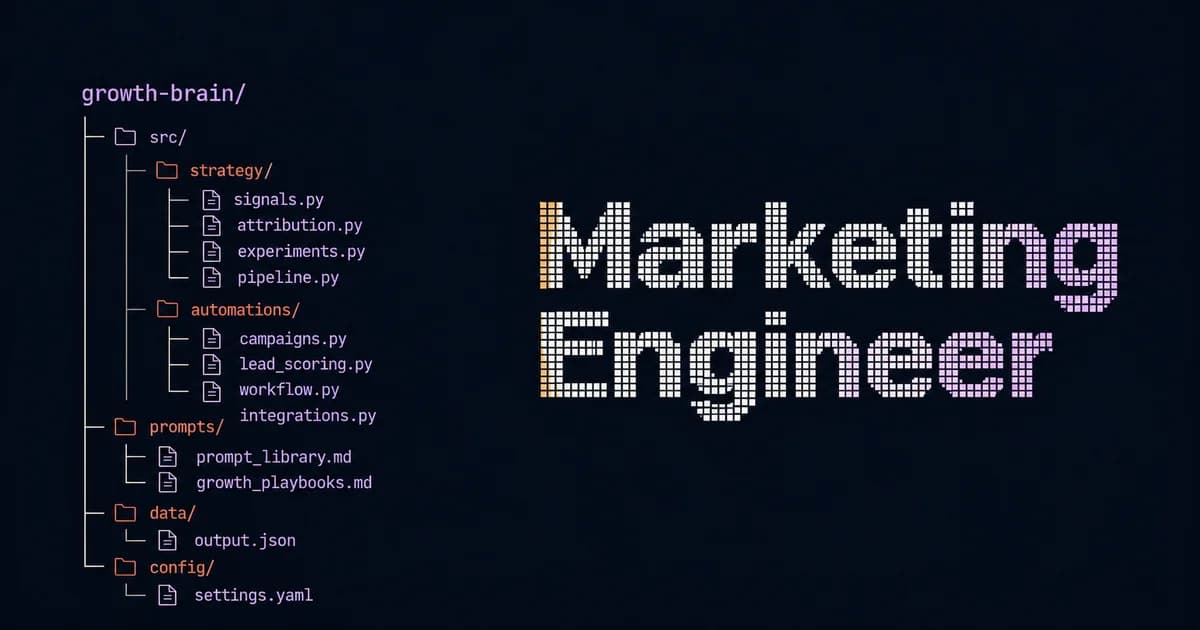
AI agents can research markets, create campaigns, and build growth tools. But when startups can access similar models, execution speed alone offers little advantage. The difference comes from the proprietary market intelligence guiding what those agents do.
A marketing engineer strategy turns customer evidence, competitive research, and search demand into a Growth Brain that guides AI agents. This framework explains how to prioritize opportunities, execute controlled experiments, and improve growth through verified business outcomes.
What Is a Marketing Engineer Strategy?
A marketing engineer strategy is a systematic approach to startup growth that combines proprietary market intelligence, AI agents, software development, and automation to identify opportunities, execute experiments, and improve business performance.
A marketing engineer is the person who builds and operates this system. They combine marketing expertise with technical capabilities to research markets, connect data sources, develop AI agents, and automate workflows that would otherwise require several specialists.
The fundamental shift is from executing individual campaigns to engineering repeatable systems that support continuous marketing experimentation.
The distinction between the role and the strategy matters. Hiring a marketing engineer gives a startup technical execution capabilities. A marketing engineer strategy defines how those capabilities contribute to business growth, which intelligence guides decisions, and how results are measured.
The strategy connects three essential components:
- Market intelligence: Customer behavior, buying motivations, competitor positioning, search demand, product data, and commercial opportunities.
- Growth engineering: AI agents, automated workflows, and software that turn validated opportunities into marketing experiments.
- Business intelligence: Acquisition, activation, conversion, revenue, and retention data that reveal which activities create value.
At the center sits the Growth Brain, a proprietary knowledge system that organizes verified intelligence, commercial priorities, and historical business decisions. It gives specialized AI agents a common foundation for making recommendations and executing approved activities.
Marketing engineering overlaps with established disciplines. Marketing operations focuses on the technology, processes, and data supporting marketing execution. Growth engineering applies technical experimentation across acquisition, activation, retention, and monetization. Their responsibilities often overlap in startups, where one technical marketer may operate across the entire customer lifecycle.
The objective is not to replace every marketing specialist. It is to give a startup the ability to turn market knowledge into measurable growth experiments without rebuilding its execution process for every new opportunity.
Why AI Agents Alone Won't Create a Growth Advantage
AI agents can research competitors, generate content, build landing pages, personalize outreach, and analyze campaign performance. But competitors can access similar models and automation platforms.
Execution capability becomes less differentiated when everyone can acquire it.
The advantage comes from knowing which customers to target, what problems matter to them, how competitors are positioned, and which opportunities deserve investment.
AI agents can analyze this intelligence, but generic prompts cannot reliably reproduce a startup's private customer conversations, product usage data, and historical commercial experience.
Four problems limit the value of standalone AI agents:
- Weak business context: Generic market descriptions produce broad positioning, repetitive content, and recommendations disconnected from actual customers.
- Wrong growth priorities: Agents can generate more leads even when the startup's main problem is converting or retaining existing customers.
- Output-based measurement: Publishing more articles, producing more advertisements, or sending more emails measures activity rather than commercial improvement.
- Inadequate controls: Agents introduce software costs, execution errors, security risks, and additional operational complexity.
Consider a startup deploying AI agents to publish comparison pages targeting dozens of competitors. Without evidence of buyer demand, product differentiation, or commercially relevant search opportunities, the system may simply produce interchangeable content.
A stronger approach connects five components:
Market Intelligence → Growth Brain → Decisions → AI Execution → Revenue Learning
Market research identifies problems and opportunities. The Growth Brain organizes supporting knowledge. AI agents recommend and execute approved experiments. Business results determine what deserves further investment.
Competitors may replicate the tools and workflows. They cannot automatically reproduce the company's first-party customer evidence and accumulated experimental knowledge.
The competitive advantage is not the number of AI agents operating. It is the quality of the decisions those agents are equipped to support.
Start With One Growth Bottleneck Across the Full Funnel
Before building AI agents, a marketing engineer must identify what is preventing the startup from growing.
Automating customer acquisition creates limited value if the real problem is poor conversion, weak product activation, or customers leaving shortly after purchasing.
Growth priorities also change with the company's maturity. A pre-product-market-fit startup needs evidence that customers consistently receive value. An early-traction business may struggle to acquire customers predictably. A scaling company may need to improve acquisition economics, activation, or retention.
The marketing engineer should investigate the full customer journey:
- Awareness: Are enough relevant buyers discovering the brand?
- Acquisition: Are marketing channels attracting prospects who match the ideal customer profile?
- Activation: Do new users experience the product's core value?
- Conversion: Are qualified prospects becoming paying customers?
- Retention: Do customers continue using and paying for the product?
These stages should be evaluated together using customer research, CRM records, funnel analysis, and retention cohorts.
Consider a hypothetical B2B SaaS startup generating 1,000 monthly registrations, but only 50 accounts complete the setup required to experience its core functionality.
Increasing acquisition could bring more users into the same broken onboarding process. Improving activation may be a more valuable first experiment.
The next step is to define one primary growth objective supported by a clear metric.
For an early-stage SaaS company, this might be the percentage of qualified accounts reaching a meaningful activation milestone. A more established business might prioritize customer acquisition cost, CAC payback, or retention.
The marketing engineer should document the affected customer segment, observed problem, current baseline, proposed improvement, and success criteria.
This provides a commercial direction for the intelligence system. Instead of searching for opportunities everywhere, the Growth Brain and its agents can focus on evidence relevant to the startup's most important constraint.
Collect Market Intelligence AI Can't Generate on Its Own
A marketing engineer can research almost any market using AI, but the most valuable intelligence often comes from information a general-purpose model cannot access or independently verify.
Real customer conversations, internal business data, purchasing decisions, and reasons customers reject a product reveal how a specific market behaves.
The objective is to combine public market research with first-party evidence and original analysis. One technically capable marketer can coordinate much of this work using research agents, APIs, and automated data processing.
Start with first-party customer intelligence.
Most startups already possess useful information scattered across sales, customer support, analytics, and CRM platforms.
The marketing engineer should collect:
- Sales conversations: Buying motivations, objections, budget constraints, and reasons prospects choose competitors.
- Customer interviews: Unmet needs, purchasing criteria, alternative solutions, and the language customers use to explain problems.
- Support tickets: Product frustrations, missing capabilities, recurring complaints, and unmet expectations.
- Product analytics: Onboarding friction, feature adoption, activation patterns, and retention.
- CRM and revenue records: Won and lost deals, customer segments, contract values, acquisition sources, and churn reasons.
AI agents can process transcripts, classify objections, group recurring problems, and identify patterns across customer segments.
However, an extracted pattern is not automatically a verified market finding. The original records should remain available, and consequential interpretations should be reviewed.
For example, if several customers say a product is difficult to implement, the agent can identify that recurring complaint. Further investigation is needed to establish whether the problem affects a broader segment and whether simpler implementation would influence purchasing decisions.
Expand with external market intelligence.
A separate research workflow can investigate:
- Competitor positioning, pricing, features, and product updates.
- Customer reviews and public complaints about competing products.
- Emerging use cases and underserved customer segments.
- Industry developments and relevant buying signals.
- Alternative solutions customers consider before purchasing.
External research reveals the wider competitive landscape. Internal customer data shows how that landscape affects the startup's actual customers.
Their combination can uncover opportunities neither source would identify alone.
For example, customer interviews may show that agencies struggle with complicated software onboarding. Competitor research may reveal that existing providers emphasize extensive functionality while offering limited implementation guidance.
That creates a positioning hypothesis worth testing, not a proven market opportunity.
Preserve evidence quality.
Each important observation should include its source, collection date, relevant customer segment, and supporting context. Research involving customer recordings or personal information must also follow appropriate consent, access, and data-protection requirements.
Separate public facts, original observations, and interpretations awaiting validation.
Public market information can be collected by many competitors. First-party evidence and original research are harder to reproduce.
The advantage comes from transforming these sources into reliable intelligence that reflects how the startup's customers actually think, purchase, and use its product.
Map How Buyers Find and Shortlist You in Google and AI Search
A marketing engineer must understand not only what customers search for, but which brands they discover, compare, and consider before purchasing.
Traditional search intelligence reveals commercial demand. AI-generated answers add another perspective by showing which providers appear in recommendations, how they are described, and which sources are referenced.
Start with commercial keywords, comparison searches, customer questions from sales conversations, and problems identified through market research.
Then examine how Google, ChatGPT, Perplexity, Gemini, and other relevant AI search experiences represent the market.
The marketing engineer should track:
- Search demand: Commercial keywords, comparison queries, and questions indicating purchase intent.
- Brand recommendations: Which providers appear in AI-generated answers and for which customer needs.
- Brand positioning: How AI systems describe competitors' strengths, limitations, and differentiation.
- Citations and sources: Which websites, reviews, and publications appear as supporting references.
- Visibility gaps: Where the startup is absent, inaccurately described, or poorly supported by relevant evidence.
Google Search Console provides dedicated Generative AI performance reporting for supported Google Search and Discover experiences. Bing Webmaster Tools offers AI Performance reporting that includes citation activity and grounding-query information across supported Microsoft AI experiences.
Specialized platforms can supplement these sources with repeated prompt monitoring and competitive comparisons. However, their datasets are samples of selected AI experiences, not complete records of every recommendation made to real users.
Turn visibility data into market intelligence.
Suppose a startup finds that competing products are repeatedly recommended for a customer need its product also addresses.
The marketing engineer should investigate whether the gap reflects product limitations, unclear positioning, insufficient relevant content, or a lack of supporting third-party evidence.
Webvy's structured authority framework provides four useful dimensions:
- Retrievability: Can search and AI systems discover the relevant information?
- Interpretability: Can they identify what the product does and whom it serves?
- Corroboration: Is the positioning supported by credible, consistent evidence?
- Answer-fit: Does available information address the specific question a buyer is asking?
Identifying visibility gaps is only the first step. A GEO and AEO strategy turns those findings into priorities for brand positioning, answer-ready content, and third-party authority, helping the startup compete for commercially relevant AI search recommendations.
The objective is not to manufacture AI mentions. Google's guidance emphasizes useful, original content and established SEO fundamentals rather than producing large volumes of pages for query variations.
AI visibility is also not equivalent to revenue. Its value comes from revealing commercially relevant discovery and positioning gaps that warrant further investigation.
Build the Growth Brain: The Core of a Marketing Engineer Strategy
The Growth Brain is a proprietary intelligence system that organizes a startup's market knowledge, customer evidence, commercial priorities, and business decisions into information AI agents can retrieve and use.
It is the central asset of a marketing engineer strategy because it connects research with decision-making and preserves what the business learns through experimentation.
A conventional knowledge base stores information. An AI context layer supplies relevant information to models. The Growth Brain extends these capabilities by connecting verified evidence to business objectives, decisions, and measured outcomes.
It is a proposed operating framework, not a single software product.
Organize the intelligence into six categories.
- Company and customer fit: Business model, ideal customer profile, target segments, positioning, product capabilities, pricing, and unit economics.
- Customer intelligence: Buying motivations, sales objections, support requests, product usage, and churn reasons.
- Competitive intelligence: Competitor positioning, features, pricing, and important market changes.
- Search and AI visibility: Commercial demand, buyer prompts, recommendations, cited sources, and positioning gaps.
- Brand knowledge: Founder perspectives, editorial standards, approved claims, and examples of accepted and rejected messaging.
- Business decisions: Historical campaigns, experiment results, rejected hypotheses, and documented commercial lessons.
This information can be stored across structured database records, documents, and version-controlled files.
The Growth Brain does not need to contain every company document. It needs the information that can materially improve decisions.
Separate verified knowledge from untested assumptions.
Three knowledge layers prevent AI-generated interpretations from becoming established company facts.
Verified intelligence contains approved business information and observations supported by identifiable evidence.
Working hypotheses contain potential opportunities, suspected customer needs, and interpretations requiring validation.
Decision and learning history records approved actions, experiment conditions, results, rejected approaches, and conclusions supported by the available evidence.
Each significant entry should retain its source, date, relevant segment, confidence assessment, owner, and review status.
These details allow agents to distinguish approved facts from speculative findings and identify knowledge that needs refreshing.
Give agents relevant context, not unrestricted access.
Effective context engineering focuses on supplying the information needed for a particular task. Retrieval-augmented generation can help agents find relevant documents and structured records without loading the entire knowledge base into every interaction.
For example, an acquisition agent may need customer segments, buying objections, competitor positioning, and approved offers.
A content agent may need search intelligence, verified product capabilities, editorial guidance, and supporting sources.
A performance agent may require campaign identifiers, customer acquisition costs, experiment records, and revenue data.
All three operate from the same underlying intelligence, but their access and instructions differ.
Protect the integrity of company knowledge.
Agents can collect observations, flag contradictions, and propose updates. They should not independently turn an interpretation into an approved commercial fact.
Human reviewers remain responsible for validating consequential findings and changes to positioning, pricing, or strategic direction.
The Growth Brain also needs maintenance. Customer needs evolve, competitor offerings change, and previous assumptions become outdated.
Its long-term value comes from preserving verified intelligence and connecting that intelligence to the company's accumulated commercial experience.
Use the Growth Brain to Decide What to Build, Test, and Stop
The value of the Growth Brain becomes visible when AI agents use its intelligence to identify and prioritize opportunities that can improve business performance.
Instead of generating ideas from generic prompts, agents evaluate customer evidence, competitive gaps, commercial objectives, and previous results to recommend where the startup should invest.
Potential opportunities include underserved customer segments, emerging demand, recurring purchasing objections, competitor weaknesses, search visibility gaps, and conversion problems.
But identifying an opportunity is not the same as establishing that it deserves investment.
Evaluate each opportunity against consistent criteria.
- Customer fit: Does the opportunity address a problem experienced by the startup's ideal customers?
- Potential impact: Could solving it improve acquisition, activation, conversion, or retention?
- Evidence strength: Is the recommendation supported by customer research, observed behavior, or reliable external information?
- Execution cost: What development work, operating expenses, and specialist resources are required?
- Confidence: Which assumptions remain uncertain, and what would validate them?
Frameworks such as RICE can help compare initiatives using reach, impact, confidence, and effort. These scores are prioritization aids, not forecasts of actual returns.
Consider a hypothetical SaaS startup struggling with trial activation.
Its Growth Brain identifies two opportunities: publishing 20 articles targeting broad industry keywords or improving an onboarding step where qualified users repeatedly abandon setup.
The content opportunity may support long-term discovery, but its expected commercial impact is uncertain.
The onboarding opportunity has stronger first-party evidence and directly addresses the company's current bottleneck. It therefore deserves higher priority for testing.
Turn recommendations into growth opportunity records.
Before approving an experiment, the agent should produce a short decision record containing:
- The target customer and identified problem.
- Supporting evidence and remaining uncertainties.
- The proposed action and commercial rationale.
- Estimated resources and execution risks.
- The primary success metric and stopping conditions.
- The person responsible for approval.
Every recommendation should answer one question:
Why should solving this specific problem for this customer segment improve a measurable business outcome?
If the evidence is insufficient, the opportunity should return to research rather than proceed to execution.
AI agents can rank opportunities, identify conflicting evidence, and suggest which activities to stop. Humans should retain authority over major budgets, pricing, commercial promises, and strategic direction.
A stronger marketing engineer strategy creates a disciplined process for deciding what deserves investment, what requires further validation, and what should stop consuming resources.
Connect AI Agents to Run Controlled Growth Experiments
A marketing engineer turns approved opportunities into coordinated experiments executed by specialized AI agents.
Each agent receives relevant intelligence from the Growth Brain, a defined responsibility, and limits on what it can access or change.
The objective is not to build dozens of autonomous agents. It is to create a repeatable execution system in which experiments are driven by verified business evidence.
Assign agents across the customer lifecycle.
Acquisition agents research commercial search demand, identify qualified prospects, prepare SEO and GEO content, develop advertising concepts, and draft outreach based on verified buying signals.
Conversion agents build landing pages, interactive calculators, comparison assets, and lead qualification workflows tailored to specific customer segments.
Activation and retention agents analyze onboarding friction, suggest lifecycle improvements, identify customer disengagement, and prepare relevant reactivation communications.
Performance agents evaluate experiment results, identify anomalies, and propose changes to future campaigns.
The marketing engineer coordinates these capabilities through coding agents, workflow automation, APIs, CRM systems, and shared data infrastructure.
Define the experiment before execution.
Every approved experiment needs a documented hypothesis, target segment, primary metric, comparison method, and decision criteria.
For example, a hypothetical SaaS startup discovers that qualified trial users frequently abandon onboarding.
A research agent examines the customer evidence. A development agent prepares a simplified onboarding experience. The marketing engineer reviews the change before deploying it to an eligible test group.
Product experimentation tools can assign users to different variants and measure predefined outcomes.
However, results should not be interpreted as conclusive without considering sample size, assignment quality, and the observation period.
Enforce controls through software.
Research agents should begin with limited, read-only permissions. Content and development agents can prepare drafts or preview deployments.
External communications, publishing, production deployments, and budget changes should require appropriate authorization.
Workflow systems can enforce approval steps before sensitive actions. Spending limits, suppression lists, duplicate-action prevention, and access restrictions should also be implemented in code rather than relying only on natural-language instructions.
Maintain logs of agent actions, failures, approvals, and costs.
Start with one reliable workflow before adding more agents. Every new capability should solve a specific operational problem or improve a measurable commercial outcome.
The marketing engineer's advantage is the ability to move from validated intelligence to a functioning experiment without rebuilding the process each time.
The Marketing Engineer Tech Stack: Tools for Building a Growth System
A marketing engineer needs tools to collect market intelligence, maintain the Growth Brain, build AI agents, execute growth experiments, and measure commercial results.
The strongest stack connects these capabilities without locking proprietary business knowledge into any single AI platform.
Customer intelligence: Fathom
Fathom records and transcribes meetings, generates summaries, and makes customer conversations searchable. A marketing engineer can use it to extract buying motivations, objections, feature requests, and recurring customer problems. Supported integrations and APIs allow meeting information to feed other workflows.
Market research and B2B prospecting: Clay
Clay combines company research, data enrichment, AI-powered web research, and buying-signal monitoring. It helps identify target accounts, research decision-makers, and detect commercial opportunities such as hiring, funding, or technology changes.
SEO and AI search intelligence: Semrush and Profound
Semrush provides traditional SEO research alongside AI visibility analysis, prompt research, and competitor benchmarking through its relevant toolkits.
Profound specializes in monitoring AI-generated answers, brand mentions, citations, and competitive visibility across supported answer engines.
Both provide intelligence about how buyers discover and evaluate brands. Their metrics are directional indicators, not direct measurements of revenue.
Growth Brain database: Supabase
Supabase provides PostgreSQL infrastructure for structured market research, customer intelligence, hypotheses, and experiment records. Its pgvector extension supports semantic retrieval of relevant knowledge.
The marketing engineer must still design the knowledge structure, evidence validation, permissions, and update workflows.
Version control: GitHub
GitHub manages version-controlled code, agent instructions, workflow configurations, and documentation. It preserves change history and supports collaboration and reviews.
Sensitive customer records belong in appropriately secured data systems, not ordinary code repositories.
AI agent development: Claude Code, Codex, or Cursor
These AI coding tools help develop custom agents, software, API integrations, and marketing automation. With approved access to external systems, they can also support data analysis and recurring research tasks.
Generated code and automated actions still require testing, security controls, and appropriate review.
Workflow orchestration: n8n
n8n connects AI agents with databases, CRM systems, APIs, and marketing platforms. It supports scheduled workflows and human approval before selected agent actions, making it useful for automating research, campaign preparation, and reporting.
Landing pages and applications: v0
v0 helps build landing pages, interactive calculators, and full-stack web applications from natural-language instructions. These assets can support customer acquisition and conversion experiments, with testing and review before deployment.
Advertising creative: Creatify
Creatify generates AI advertising videos, product demonstrations, and creative variations. It can accelerate production and help test different campaign concepts, but performance must be validated through actual advertising results.
CRM and lifecycle automation: HubSpot Agent Hub
HubSpot provides CRM records and lifecycle workflows. Agent Hub, formerly Breeze Agents, supports AI agents for prospecting, customer interactions, and data research, with capabilities and usage costs depending on the subscription.
Product analytics and experimentation: PostHog
PostHog measures conversion funnels, activation, retention, and product behavior. It also supports feature flags and controlled experiments, helping the marketing engineer evaluate whether changes improve customer outcomes.
Revenue and billing data: Stripe
Stripe provides payment and subscription records for businesses using its billing infrastructure. Connecting this data with CRM and product analytics helps evaluate paying customers, revenue, and retention. Accurate campaign attribution requires additional data integration and consistent identifiers.
Start with a minimum viable stack.
An AI coding agent, n8n, Supabase, PostHog, and an existing CRM can provide the foundation for a startup's first Growth Brain workflows.
Add specialist research, GEO/AEO, prospecting, and creative platforms when they address a validated business need. Evaluate integration access, subscription costs, security, and maintenance before expanding.
The Growth Brain should remain independent of individual tools. Models and software will change, but proprietary intelligence, validated decisions, and historical experiment results should remain accessible and portable.
Measure Revenue Impact and Feed It Back Into the Growth Brain
A marketing engineer strategy becomes more valuable when experiments produce reliable evidence that improves future decisions.
Agents can launch campaigns, generate leads, and change conversion funnels. Those activities matter only when they contribute to commercially useful outcomes.
The Growth Brain should connect marketing execution with customer acquisition, product activation, revenue, and retention.
Connect marketing activity to business outcomes.
Use consistent identifiers across campaign records, CRM opportunities, product events, and billing data.
Where practical, preserve campaign source, target segment, experiment assignment, associated accounts, and customer outcomes.
This allows the marketing engineer to evaluate:
- Qualified pipeline: Which activities generate opportunities that fit the ideal customer profile?
- Activation: Which acquisition sources bring customers who experience the product's core value?
- Trial-to-paid conversion: Which segments become paying customers?
- Customer acquisition cost: What is the total sales and marketing acquisition cost per new paying customer?
- CAC payback: How long does it take to recover acquisition costs through customer gross profit?
- Retention: Which customers continue using and paying for the product?
- Net revenue retention: How does recurring revenue from existing customers change after expansion, contraction, and churn?
CAC calculations should include relevant advertising, software, content production, agency expenses, and sales or marketing labor. Implementation and maintenance expenses must also be considered when assessing the economics of an AI workflow.
Distinguish attribution from incremental growth.
Attribution connects a conversion to recorded marketing interactions. It does not establish that those interactions caused the purchase.
Controlled experiments provide stronger evidence.
A startup may test different onboarding experiences, randomly withhold an outbound campaign from a comparable group of eligible accounts, or use another valid experimental design.
Results must account for sample sizes, customer differences, sales-cycle length, and measurement limitations.
If the evidence is inconclusive, the performance agent should say so rather than recommend scaling based on an unreliable result.
Turn outcomes into validated business knowledge.
The Growth Brain should follow a structured learning cycle:
Observation → Hypothesis → Experiment → Result → Verified Learning
Consider a SaaS startup testing simplified onboarding.
Its performance agent compares activation between correctly assigned groups, then reviews subsequent paid conversion and retention when sufficient data becomes available.
The system records the hypothesis, experiment conditions, measured outcomes, uncertainties, and approved conclusions.
Unsuccessful experiments also matter. They reveal which assumptions failed and can prevent repeated investment in ineffective approaches.
Agents can propose updates, but they should not automatically convert ambiguous results into verified business knowledge.
Over time, the Growth Brain accumulates increasingly specific evidence about which customers, offers, messages, and workflows perform well for the startup.
That learning, rather than the volume of automated activity, is the foundation for improving future growth decisions.
How to Build Your Marketing Engineer Growth System in 90 Days
A startup does not need dozens of AI agents to implement a marketing engineer strategy.
The first 90 days should establish a reliable process for turning market intelligence into measurable experiments.
The implementation can be organized into three stages, each with a clear decision gate before expanding the system.
Days 1–30: Build the Intelligence Foundation
The first month focuses on understanding the business and organizing reliable evidence.
The marketing engineer should:
- Define the ideal customer profile and primary growth bottleneck.
- Collect relevant customer conversations, CRM records, competitive research, and product analytics.
- Establish a Google and AI search visibility baseline where commercially relevant.
- Organize verified facts, hypotheses, and decisions inside the Growth Brain.
- Connect essential acquisition, product, and revenue data.
Decision gate: The startup understands its principal growth constraint and has enough reliable evidence to prioritize an initial experiment.
Days 31–60: Connect Agents and Launch Experiments
Build the first specialized agent around a recurring workflow that directly supports the growth objective.
This could involve qualifying prospects, identifying search opportunities, preparing landing pages, or analyzing onboarding friction.
Connect the relevant tools, define permissions, and establish an approval process.
Each experiment should specify its hypothesis, target segment, baseline or control, primary metric, and stopping conditions.
Decision gate: The system can consistently move from a supported opportunity to an approved, measurable experiment.
Days 61–90: Measure, Learn, and Improve
Evaluate the initial experiments and determine which workflows deserve continued investment.
Compare outcomes against predefined success criteria, including operating costs and limitations in the available evidence.
Feed validated findings into the Growth Brain. Improve unreliable workflows and stop automations that add complexity without enough business value.
Decision gate: At least one workflow has generated useful commercial evidence and can be operated reliably.
Establish a weekly operating rhythm.
Begin each week with a performance review and opportunity prioritization. Use the middle of the week for building and launching approved experiments. Finish by reviewing customer feedback, agent performance, and new intelligence.
The founder retains responsibility for strategic direction and major commercial decisions. The marketing engineer owns the technical growth system, bringing in specialists for product development, analytics, or GEO/AEO when the work requires deeper expertise.
The 90-day framework is an implementation plan, not a guaranteed growth timeline.
The goal is not a fully autonomous marketing department. It is a growth system that knows what to investigate, executes approved experiments, and makes better decisions as verified business evidence accumulates.
FAQs
What is a marketing engineer strategy?
A marketing engineer strategy connects market intelligence, a proprietary knowledge system, AI-assisted execution, and business measurement. It defines how opportunities are identified, which activities agents can perform, and how validated results inform future growth decisions.
What is a Growth Brain in marketing engineering?
A Growth Brain is a maintained system containing customer intelligence, competitive research, positioning, commercial objectives, and historical experiment results. It provides relevant context for AI agents and records verified lessons that can guide future marketing decisions.
How is a Growth Brain different from an AI knowledge base?
A knowledge base stores information. A Growth Brain connects verified evidence with commercial objectives, hypotheses, decisions, and measured outcomes. Its purpose is to improve growth decisions rather than simply supply background information to AI models.
Can one marketing engineer collect intelligence for an unfamiliar market?
Yes. AI-assisted research can help one person investigate competitors, customer segments, market demand, and purchasing behavior. However, reliable conclusions still require source verification, primary customer evidence, and domain expertise where necessary.
What is the difference between a marketing engineer and a growth engineer?
The responsibilities overlap. Marketing engineers generally concentrate on marketing systems, acquisition workflows, and campaign infrastructure. Growth engineers may work more extensively across product activation, retention, and monetization. Startups often combine these capabilities in one role.
Which tools should a marketing engineer learn first?
Start with an AI coding environment, a workflow automation platform, structured data storage, product analytics, and the existing CRM. Claude Code, n8n, Supabase, and PostHog are possible options. Add specialist tools only when required by a validated workflow.
How do AI agents use proprietary market intelligence?
Agents retrieve relevant customer evidence, positioning, commercial constraints, and previous decisions from the Growth Brain. They use this context to research opportunities, prepare experiments, and evaluate alternatives. Important recommendations still require evidence checks and appropriate approval.
Can AI agents automate SEO and AI search optimization?
AI agents can support keyword research, prompt tracking, competitive analysis, content preparation, and technical workflows. However, automation cannot guarantee rankings, mentions, or citations. Valuable original content, sound SEO practices, and credible supporting evidence remain important.
What should a startup automate first?
Start with a well-understood bottleneck and a measurable outcome. If customer activation is weak, investigate onboarding before expanding acquisition. Build one reliable workflow, validate its results, and increase automation only when the business case is clear.
Can AI agents make marketing decisions without human approval?
Agents can make limited operational decisions within defined permissions. Actions involving significant budgets, public claims, customer communications, or production changes require appropriate authorization. Approval requirements and spending limits should be enforced through software controls.
How do you measure the ROI of a marketing engineer strategy?
Compare implementation, software, model, maintenance, and labor costs against improvements in qualified acquisition, activation, revenue, and retention. Use controlled comparisons when possible and distinguish attributed conversions from evidence of incremental growth.
How long does it take to build a marketing engineer growth system?
Ninety days is a practical planning framework for establishing a Growth Brain, launching an initial agent workflow, and measuring early experiments. The actual timeline depends on data quality, technical complexity, team capacity, and the startup's growth stage.

Webvy is a GEO, AEO and AI SEO agency helping brands improve visibility across AI search engines.